
Auroville and UNESCO
Statements of Support

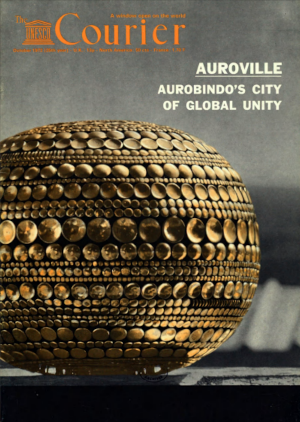
The General Assembly of UNESCO (United Nations Educational, Scientific and Cultural Organization) unanimously passed in 1966, 1968, 1970 and 1983 resolutions of support to Auroville, inviting member states and international non-governmental organisations:
“to participate in the development of Auroville as an international cultural township designed to bring together the values of different cultures and civilisations in a harmonious environment with integrated living standards which correspond to man’s physical and spiritual needs.”
It reads as follows:
2017
Cooperation of UNESCO with the international township of Auroville, India
The General Conference,
Recalling the foundation of an international township, Auroville, in South India on February 28, 1968, when the youth of 124 Member States participated in the ceremony by depositing the soil of their countries in the foundation urn to symbolize the coming together of the nations of the world,
Noting that the General Conference of UNESCO unanimously adopted resolutions of support to Auroville in 1966, 1968, 1970 and 1983, inviting Member States and international non-governmental organizations to participate in the development of Auroville as an international cultural township designed to bring together the values of different cultures and civilizations in a harmonious environment with integrated living standards which correspond to man’s physical and spiritual needs,
Recognizing that the aims of Auroville are to promote international understanding, peace, innovative education, a learning society and all-round material and spiritual development for harmonious individual and collective growth, and that such aims contribute to the advancement of the objectives of UNESCO, especially dialogue among civilizations, cultures and religions, cultural diversity and culture as a factor for development,
Appreciating that the Government of India passed, in 1988, the Auroville Foundation Act for the purpose of protecting and encouraging the development of Auroville,
Also appreciating that Auroville International Centres have been established in many countries of the world, which are engaged in bringing youth from their countries into contact with the aims and ideals of Auroville and in facilitating internships, volunteer stays and academic research programmes,
Also recognizing that Auroville has developed into a centre of expertise in a wide range of fields, benefiting India and noting its success in sharing its experience and helping the development of its neighboring rural population,
Acknowledging that Auroville is inviting all nations of the world to participate in its development, especially of its International Zone, which is designated as an educational campus hosting cultural pavilions of all nations or groups of nations, expressing the genius of each culture,
Also noting that 28 February 2018 will mark the 50th anniversary of the founding of Auroville,
Further recognizing that Auroville is a successful and unique model project, proving the capacity of an international community, after almost 50 years of existence, to continue to live up to its initial founding ideas of peace and international harmony and which are also UNESCO’s own values and principles, as well as some of its major priorities,
Invites the Director-General to reinforce the association of UNESCO with Auroville and organize commemorative activities for its 50th anniversary, and to re-invite the Member States on the special occasion of Auroville’s 50th anniversary to participate in Auroville’s further development.
2014
Sri Aurobindo Statue at UNESCO — Address by Irina Bokova, Director-General of UNESCO on the occasion of the ceremony to mark the new location of the statue of Sri Aurobindo: the Garden of Peace, UNESCO Headquarters, Paris, France
“Today, the great sage Sri Aurobindo looks onto the Garden of Peace with his penetrating expression and humble demeanour, so eloquently expressed by the talented artists of Calcutta.
In this House, which Jawaharlal Nehru described as the ‘conscience of humanity,’ Sri Aurobindo’s spirit stands as a universal inspiration.
In the West, one might describe Sri Aurobindo as a ‘renaissance man’ — an immense philosopher, a scholar, a poet, who started his life fighting for India’s freedom and who, in captivity, launched a lifetime exploration of the unlimited potential for good and creativity of the human soul.
To him, we owe also the magisterial commentary of the Bhagavad Gita — the gift of sharing understanding of Hinduism’s deepest sources across all borders, the gift of drawing bridges of understanding between western and eastern cultures, between all societies.
The life of Sri Aurobindo was inspired by a deep devotion to human dignity and freedom, guided by his vision of life as an opening of the mind.
The stars might find it is no coincidence he was born on the day that India achieved independence, when he appealed for unity, peace and concord, qualifying his great nation as a ‘helper and leader of the whole human race.’
Sri Aurobindo embodied the conviction that the ethical and spiritual dimension — the quest for self-knowledge — offered the most fertile ground for creating more peaceful, just and harmonious societies.
He inspired educators and generations of disciples, with the founding of his Ashram in Pondicherry in 1926.
Sri Aurobindo will also forever be associated with the founding of Auroville — a unique international township founded in 1968, as a place where people from different cultural, educational and political backgrounds can work together towards the common goal of unity through diversity. I have indeed visited this magical place.
Today, his learning and vision continue to draw devotees from the world over — following his profound Integral Yoga teachings.
As he wrote, ‘true knowledge is not attained by thinking — It is what you are and it is what you become.’ …
Today is indeed a celebration — of India’s wisdom and contribution to humanity, of humanism and of the importance to seek understanding of ourselves and of others.”
2008
40th Anniversary of Auroville — Address by Mr Koïchiro Matsuura, Director-General of UNESCO, on the occasion of a Round Table marking the 40th anniversary of Auroville
“I am delighted to welcome you all to UNESCO Headquarters to celebrate the 40th anniversary of the establishment of Auroville.
Allow me first to express my sincere thanks to Ambassador Bhaswati Mukherjee and the Permanent Delegation of India to UNESCO for organizing today’s round table and musical performance in celebration of Auroville. The light of the lantern we have just lit is an apt symbol of the strong cooperation between India and UNESCO – and indeed all UNESCO’s Member States – in our work to build a more just and sustainable world. It also symbolizes the enduring spirit of hope that has driven Auroville since its establishment forty years ago.
Over the last four decades, UNESCO has enjoyed a special relationship with this unique international township in south India. During its foundation ceremony in February 1968, young people representing 124 UNESCO Member States deposited soil from their respective countries on the site of the future township to illustrate the fundamental concept of ‘unity in diversity’. Since that historic day, UNESCO has regularly reiterated its support for Auroville, a place that embodies many of the principles underlying the Organization’s worldwide action to promote cultural diversity, intercultural dialogue and lifelong learning as the basis for peaceful, sustainable societies.
Forty years ago, the founders of Auroville set a most noble objective: to create a place where people from different cultural, educational and political backgrounds can meet and work together towards their common goal of sustainable living. Thus, Auroville stands out as an unparalleled human experiment in transforming these ideals into reality. These same principles inform all aspects of life there, from its urban design to its economic structures and system of governance. Since its foundation, this constantly evolving community has launched innovative projects in areas as diverse as environment, health, education and social enterprise.
In so doing, Aurovillians have also worked closely with the inhabitants of the surrounding villages to help them improve their living conditions. The outlying rural region, considered by the local government as among India’s most underdeveloped areas, has benefited greatly from Auroville’s presence. Some 5,000 people from local communities have found employment in the township, and a number of health and educational facilities have been created to serve them.
Furthermore, following the havoc wreaked by the 2004 tsunami, Aurovillians sprang into action organizing emergency aid. Since then, the Auroville Tsunami Relief and Rehabilitation Project has been hard at work to ensure long-term rehabilitation and awareness raising through initiatives such as the “tsunamikas” dolls programme. Aurovillians are also exploring sustainable building practices and climate change to ensure better preparation for future natural disasters.
Indeed, Auroville’s ability to survive and evolve over four decades bears witness to the strength of the founding principles and the resolve and perseverance of its citizens. In today’s globalized world fraught with regional conflicts and economic instability, it is especially reassuring to witness such enduring models of solidarity and humanism.
During today’s round table representatives from the Auroville Foundation will share insights on efforts underway in their community in the fields of culture, development, education, social sciences, environment, and building technologies. I hope that the lessons learned there will inspire similar experiments in sustainable living in other parts of the world and look forward to continued collaboration between UNESCO and Aurovillians. May their light continue to shine brightly for many decades to come.”
2003
Auroville: an example of cultural diversity — Address by Mr Koïchiro Matsuura, Director-General of UNESCO at the inauguration of an exhibition on Auroville, 10 April 2003
“It gives me great pleasure to inaugurate this exhibition marking the thirty-fifth anniversary of the founding of Auroville. It is a city unique of its kind, one which brings to life a number of ideals that many of us hold dear. We are here, in fact, to celebrate the translation of an idea into practice. As an intellectual and ethical organization, UNESCO cannot fail to be fascinated by this experience.
UNESCO supported the foundation of this unusual experiment and, over the years, has continued to show interest in its unfolding development. Auroville was not created to serve the commercial or industrial needs of the region but for the sole purpose of putting into practice a set of ideals. Creating a city dedicated to peace, international understanding and human unity may have seemed a fantasy but some determined individuals made it possible. Inspired by the great Indian spiritual master Sri Aurobindo, guided by spiritual principles of the ancient Indian tradition of ‘Sanatana Dharma’, Auroville has, since its creation 35 years ago, developed into a full-fledged city of over 1500 inhabitants.
The creators of Auroville sought to create a city which could become a model for humanity. The very existence of this city makes each of us realize that such a dream is not impossible to achieve.
Many of the foundational principles guiding the Auroville community are close to the values promoted by UNESCO. And, over the years, the development of various ideas and practices has brought further similarities to the fore. For example, the increasing emphasis on dialogue, diversity and sustainable development in UNESCO’s work resonates strongly with important aspects of the ongoing Auroville experiment. For illustration, let me read a brief quotation: ‘Cultural diversity widens the range of options open to everyone; it is one of the roots of economic development, understood not only in terms of economic growth but also a means to achieve a more satisfactory intellectual, emotional, moral and spiritual existence.’ This quotation comes from Article 3 of the UNESCO Universal Declaration on Cultural Diversity but its sentiments are, I am sure, familiar to the citizens of Auroville.
I am pleased that UNESCO, working closely with the Indian Permanent Delegation, has contributed to the organization of this exhibition. Such an event will enable people to discover the existence of Auroville and to reflect upon the values it upholds, which tie in with some of UNESCO’s major priorities such as dialogue among civilizations, cultures and religions; cultural diversity and culture as a factor for development; poverty eradication; quality education and lifelong learning; and renewable energies.
Tomorrow, there will be a seminar at which more information about Auroville will be made available and where there will be a chance to discuss the theory and practice of this noble experiment with members of the Auroville community. Our institutions share a common goal of seeking the improvement of humankind’s welfare and peaceful coexistence among people belonging to different walks of life. Let us hope that this worthy project initiated in India will inspire people to live up to these ideals. It is thus with great pleasure that I declare this exhibition officially open.”
1983
Fourth UNESCO Resolution on Auroville
The General Conference,
Recalling the foundation of an international township, Auroville in South India in February 1968, when the youth of 124 Member States participated in the ceremony by depositing the soil of their countries in the foundation urn to symbolise the coming together of the nations of the world,
Noting that the Charter of Auroville, announced at the Foundation Ceremony, declared that Auroville belongs to nobody in particular but to humanity as a whole and enunciated the aims of unending education and youth that never ages, as also material and spiritual research for the living embodiment of an actual human unity,
Recognising that Auroville seeks to ensure international understanding, peace, innovative education, a learning society and all round material and spiritual development for harmonious individual and collective growth and that such aims contribute to the advancement of the objectives of UNESCO,
Recognising that during the last fourteen years, Auroville has been growing steadily and that the resident members of Auroville, including 125 children represent twenty‑four countries,
Noting that Auroville International Centres have been established in different parts of the world to work for the growth, development and promotion of the aims and objectives of Auroville,
Noting that the Government of India has taken an active interest in Auroville and has fully supported its ideals of international understanding and the unity of mankind,
Welcoming the fact that an International Advisory Council has been set up to advise the Government of India on ensuring the promotion of the ideals for which Auroville was established,
Noting that the work at Auroville aims at restoring the ecological balance of a severely deforested, eroded land by an extensive programme of afforestation, erosion control and soil conservation, and also by initiating a new approach to integrated rural and educational development,
Appreciating the experimentation in Auroville in alternative sources of energy and in new methods of economic development permitting the free pooling of resources and cooperative activities,
Recalling that in 1970 the General Conference adopted a resolution inviting Member States and international non‑governmental organisations to participate in the development of Auroville as an International Cultural Township, and inviting the Director‑General to take such steps as might be feasible, within the budgetary provisions, to promote the development of Auroville as an important international cultural programme,
Invites the Director‑General to extend all possible support for the development of Auroville and to participate in its activities within the framework of the Programme and Budget for 1984-1985.
1970
Third UNESCO Resolution on Auroville
The General Conference,
Recalling resolutions 4.36 and 4.131 concerning Auroville which were adopted by the 11th and 15th sessions of the General Conference,
Noting that the Charter of Auroville aims inter alia at establishing “a place of unending education, of youth that never ages”, and “living embodiment of an actual human unity”,
Recognising the progress made in Auroville since the foundation stone was laid on 28th February 1968,
Conscious of the new responsibilities cast on Unesco in the wake of growing unrest among youth from almost every part of the world; and which has taken the form of an open dispute with the universities and society,
Aware of the urgent need to welcome the “newly vocal young as allies in the search for a better world,” and in keeping with the spirit of the Universal Declaration of Human Rights, for the promotion among youth of ideas of peace, mutual respect and understanding between peoples, and in conformity with the Declaration of the Principles of International Cultural Cooperation,
Noting further that towards this end Auroville is already preparing and creating an instrument of education capable of meeting the formidable demands of our age, linking East and West in a new relationship,
Considering that Unesco’s Major Project on the Mutual Appreciation of Eastern and Western Cultural Values gave a pioneering start, and recognising that Auroville can be an effective and integrated and follow-up to this Project,
Requests the Director-General to take such steps as may be feasible within the budgetary provisions, to promote the development of Auroville as an important international cultural programme.
1968
Auroville and UNESCO — Address by M.S. Adiseshiah, Deputy Director General of UNESCO at the Auroville-UNESCO symposium in Pondicherry, March 1968
“We in UNESCO have tried other ways of living together and we have seen them ending in stark tragedy… We have tried in UNESCO, in the UNESCO world, which represents the plusses and minuses of humanity, which represents the world as it is, and not the world as it can be, or should be – we have tried every way, and we have failed.
And so now we turn to Auroville, and to its foundations, the firm foundation on which its human unity, its universal harmony, is to be built. That foundation is Man… Man in all his glory, in his divinity, in his unfathomable depths which he can reach, and which Auroville will make it possible for man from everywhere – from Africa, from Europe, from Asia and from the Americas – to achieve. It is not surprising therefore that UNESCO has embraced Auroville as a programme which embodies its major and fundamental purposes…
Education, which is the special domain of UNESCO, which deals with men’s minds, with men’s spirits – even education, as it has so far been practiced, has not led to peace, has not led to harmony and understanding.
The people who start wars are not the illiterate or the ignorant in Europe or America; the people who burn buses and trams in our country are not the illiterates, and since the torch-bearer of this confusion is the educated élite, UNESCO’s responsibility for seeing what kind of education should be developed is an urgent one. When I spoke of Auroville as being a hope, I had this very much in mind.
The Auroville system of education, by the way, is not a paper plan; it is already being worked out in the International Centre of Education of the Sri Aurobindo Ashram in Pondicherry.
The educational system that Auroville will have, which is now already being developed and perfected, is the system in which every man, woman and child will learn to live, and live to learn, freely and harmoniously… in a world which is frighteningly progressive.
It is the Aurovilians whom I met who are the basis of my hope. They remind me of the astronauts and the cosmonauts, who as you know, spend years training themselves for the tremendous task that they have to undertake. The Aurovilians are the cosmonauts and astronauts of this new international city of hope, of development, of prosperity and of charity. And it is their spirit which I have seen for myself, the training which they are undergoing, and the concrete pilot-work which they are doing now in actually digging the foundations of this great city, that are for me the basis of what you can call my hope for Auroville.
The first task is for every member-state, and every man, woman and child in the member-state, to understand Auroville as the international city where the ideals that we have been so long seeking for, of peace and harmony, of human unity, will be realised – realised very concretely, not simply as resolutions, as declarations, flag-waving, but through the schools, through the colleges, through the workshops, through the factories, through the farms and through the international airport which will bring men and women from all over the world.
So the first thing that UNESCO will help member-states do – and is already doing – is to understand the Auroville programme, and then see what of this programme would be the responsibility of a government, or an organisation, or a university, or an individual. We are proud of the fact that most of the member-states of UNESCO sent part of their soil, exactly a year ago, for the foundation ceremony. That symbolic action in giving a part of their land, land over which man through the ages has fought, fought bloodily, fought at the cost of lives, in the creation of a new city is a hopeful augury of the time when UNESCO and all its member-states would make their contribution – financial, material, and spiritual – for the building of Auroville.”
Second UNESCO Resolution on Auroville
The General Conference,
Recalling that in connection with commemoration of the 20th anniversary of UNESCO, the Sri Aurobindo Society, Puducherry, India, had taken steps to establish an international cultural township known as Auroville where people of different countries will live together in one community and engage in cultural, educational and other pursuits, and that this project has been commended to all those interested in UNESCO’s ideals in resolution 4.36 passed at the fourteenth session of the General Conference,
Considering that Member States, believing in the pursuit of truth and the free exchange of ideas and knowledge, have agreed and determined to develop and to increase the means of communication between their peoples,
Considering also that, despite the technical advance which facilitates the development and dissemination of knowledge and ideas, ignorance of the way of life and customs of people still presents an obstacle to friendship among the nations, to peaceful cooperation, and to the progress of mankind,
Taking account of the Universal Declaration of Human Rights, the Declaration on the Promotion among Youth of the Ideas of Peace, Mutual Respect and Understanding between Peoples and the Declaration of the Principles of International Cultural Cooperation,
Noting that the foundation stone of Auroville has been laid on 28th February 1968 and that the youth of many nations participated in this solemn ceremony symbolizing the coming together of nations in a spirit of human unity,
Confident that Auroville with its many interrelated sub‑projects will add a new dimension to UNESCO’s activities for the promotion of international co‑operation and understanding and appreciation of cultural and human values,
Invites Member States and international non-governmental organisations to participate in the development of Auroville as an international cultural township designed to bring together the values of different cultures and civilisations in a harmonious environment with integrated living standards which correspond to man’s physical and spiritual needs.
1966
First UNESCO Resolution on Auroville
The General Conference,
Being apprised that in connection with the commemoration of the twentieth anniversary of UNESCO, the Sri Aurobindo Society, Puducherry, India, a non governmental organisation affiliated to the Indian National Commission for UNESCO, proposes to set up a cultural township known as “Auroville” where people of different countries will live together in harmony in one community and engage in cultural, educational, scientific and other pursuits,
Noting that the township will have pavilions intended to represent the cultures of the world, not only intellectually but also by presenting different schools of architecture, painting, sculpture, music, etc, as part of a way of living,
Appreciating that one of the aims of “Auroville” will be to bring together in close juxtaposition the values and ideals of different civilizations and cultures,
Expresses the belief that the project will contribute to international understanding and promotion of peace and commends it to those interested in UNESCO’s ideals.
Sri Aurobindo International Institute of Educational Research
What's in a name?

Sri Aurobindo
A Force in Action

International
Auroville and the World

Institute
From Near to Far

Education
Lifelong Learning

Research
Within and Without